Salt Lake City's water calendar
Winter brings pipe freezes: December to February average below 32°F at night.1 Spring brings snowmelt, as on April 12, 2023, when Emigration Creek overflowed.2 And one fall storm dropped about 2.5 inches in 14 hours on Rose Park.3
Free service. Call now and we'll connect you with a local restoration company. How it works
Winter
When nights drop below freezing
NOAA's 1991 to 2020 normals for Salt Lake City International Airport.1
Salt Lake City's normal January overnight low. December through February average below freezing.1
| January | 24.2 °F |
|---|---|
| February | 28.6 °F |
| March | 36.3 °F |
| April | 41.8 °F |
| May | 50.4 °F |
| June | 59.1 °F |
| July | 68.2 °F |
| August | 66.6 °F |
| September | 56.3 °F |
| October | 43.6 °F |
| November | 32.8 °F |
| December | 25.3 °F |
Where pipes freeze
Along exterior walls, and in unheated spaces such as garages, attics, basements and kitchen cabinets.4
Prevention
Open cabinet doors, let cold water drip in very cold weather, keep the thermostat steady, and no lower than 55°F when away.4
Coverage catch
Frozen pipes may not be covered if the cause is negligence, such as not keeping the house heated.5
Spring: April 12, 2023, Emigration Creek
Snowmelt runoff made Emigration Creek overflow, sending water through Wasatch Hollow Park and down 1700 South and 1500 East. The city and Salt Lake County later found that a malfunctioning steel plate blocking a culvert drain was the specific trigger. Police, fire and Public Utilities crews responded, and hundreds of volunteers filled sandbags that night.2
Fall: the Rose Park cloudburst
On October 3 and 4, about 2.5 inches of rain fell in roughly 14 hours, which the National Weather Service reported as the most rainfall in a day in more than 124 years. It caused localized flooding and property damage in Rose Park near 2000 West and 800 North.3
What the city did, and did not do
After Rose Park the city placed dumpsters for drywall, carpet and furnishings, set up curbside pickup for appliances, furnaces, water heaters and mattresses, and pointed residents to a self-report form with Salt Lake County Emergency Management. Interior repairs stayed with owners: the city said private contractors may be needed for interior electrical, gas, and water or sewer work.3
Storm water is not covered by default
The Utah Insurance Department lists flood damage, and interior water damage from a storm when the roof and walls are undamaged, among things most standard homeowners policies do not cover.5 A new NFIP flood policy generally takes effect 30 days after purchase.6
How this works
What happens when you call
It is free to call, and calling commits you to nothing.
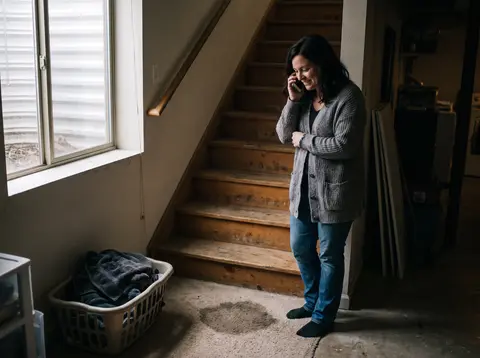
![A woman on the phone at the foot of the basement stairs, looking at a wet patch on the carpet.]() 1
You call
Tell them what happened and where. Have the address ready.
- 2
We connect you
A call network puts you through to an independent local restoration company that serves Salt Lake City and is taking calls.
![A technician crouches by a basement floor drain, explaining what she sees to the homeowner beside her.]() 3
They assess and quote
If you want a visit, they look at the damage and quote their own price. Ask for it in writing.

We are a free referral service, not a contractor. The company that answers sets its own prices. How this service works
Want a local company to look at it?
Free to call. An independent restoration company that serves Salt Lake City answers, and you decide what happens next.
Call (801) 577-3288Salt Lake Water Damage Advice is a free referral and information service, not a contractor. Calls are answered by independent local restoration companies through a pay-per-call network, and we may be paid when a call qualifies. We do not do the work and do not set prices or availability. How it works
Sources
Each numbered note on this page points here. We read every page on October 24, 2026. Where sources disagree we say so; where we could not find a source we left the claim out. We are not affiliated with any of these organizations.
- NOAA NCEI, U.S. Monthly Climate Normals 1991-2020, Salt Lake City International Airport (station USW00024127), minimum temperature. 1991-2020 normals. www.ncei.noaa.gov/access/services/data/v1?dataset=normals-monthly-1991-2020&stations=USW00…
- Salt Lake City Corporation, 2023 Salt Lake City Flooding Events. Event of April 12, 2023. www.slc.gov/em/2023-salt-lake-city-flooding-events/
- Salt Lake City Corporation, Rose Park Neighborhood Flooding. Storm of October 3-4 (year not shown in the text we read). www.slc.gov/em/rose-park-neighborhood-flooding/
- American Red Cross, Preventing & Thawing Frozen Pipes. Copyright 2026. www.redcross.org/get-help/how-to-prepare-for-emergencies/types-of-emergencies/winter-storm…
- Utah Insurance Department, Home Claims Information. No date shown. insurance.utah.gov/consumers/home-insurance/home-claims-info/
- FEMA FloodSmart (National Flood Insurance Program), Buy a Flood Insurance Policy. No date shown. www.floodsmart.gov/get-insured/buy-a-policy